Inside the work
It shows its working.
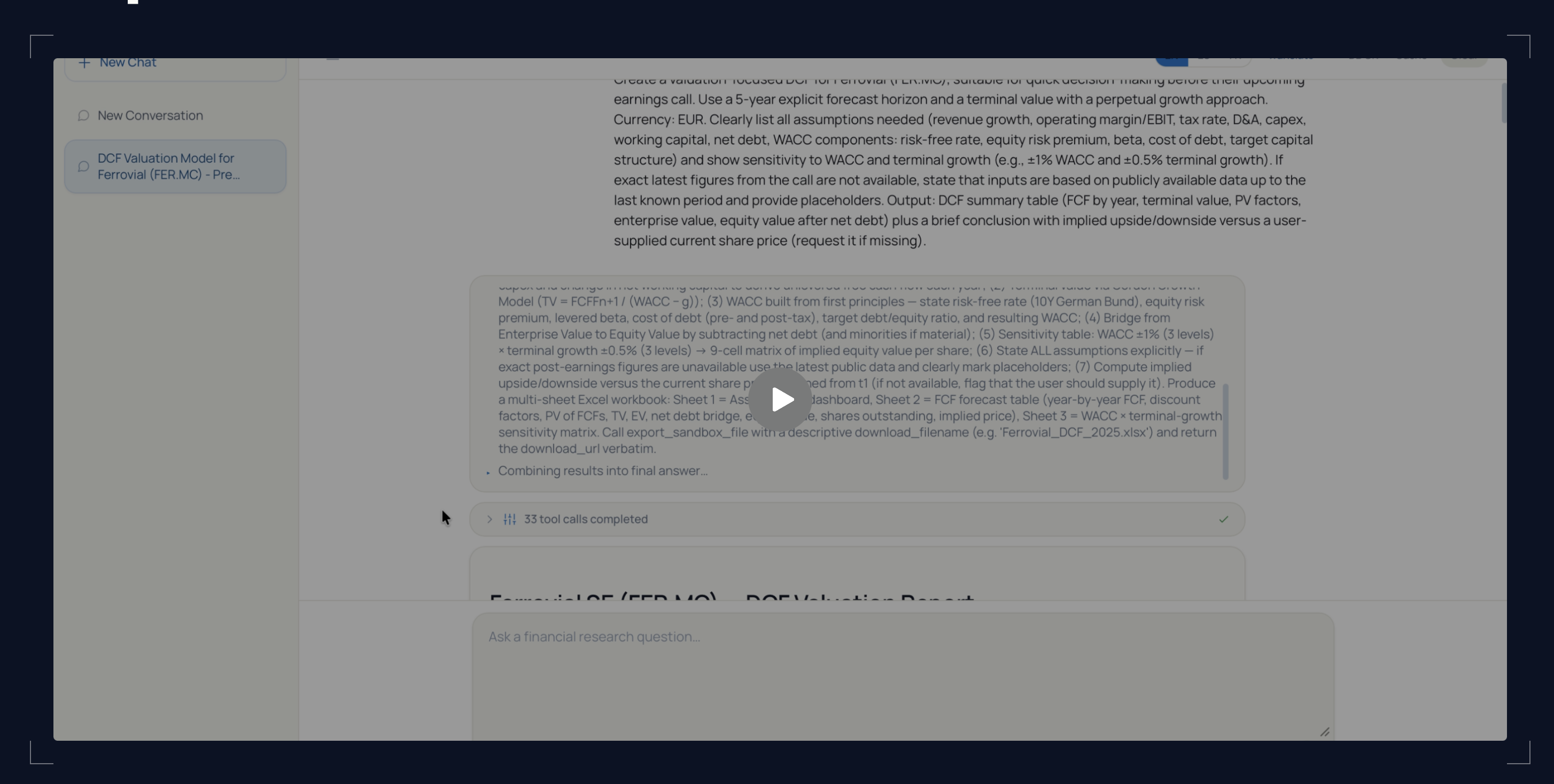
Numen doesn't just return an answer, it exposes the python it ran, the assumptions it made and the sources it read. Open any step and inspect the logic the way you'd review a junior's model.
Solutions · Private equity
Numen writes and runs the python behind every diligence step, models, comps and memos, with the maths and the audit trail attached.
Built for institutions governed by EU financial regulation.
Hosted in the EU (Google Cloud europe-west1) · encrypted TLS 1.2+ / AES-256 · your data is never used to train any model.
No third-party certification held today; SOC 2 is on our roadmap. Security whitepaper and threat model on request.
Why deal teams trust the output
Numen writes and runs the code, not a guess at a number. The model computes; you keep the script.
The same inputs return the same outputs, deterministically. Re-run any analysis and verify it cell by cell.
Every figure carries a link back to the filing, line and page it came from. No orphan numbers.
Outputs land in your house format and your IC memo structure, the way your firm already works.
Diligence, executed
Point Numen at the data room. It builds, spreads and drafts, and shows its working at every step.
Numen writes the python for a full operating model and DCF, projection, WACC, terminal value, sensitivities, straight from the filings.
It assembles the comparable set, computes the multiples and margins, and links each line to the source it was pulled from.
It writes the investment memo around the numbers, thesis, valuation, risks, in your committee's structure, every claim cited.
Product output · DCF model
| €m, fiscal year | Y1 | Y2 | Y3 | Y4 | Y5 |
|---|---|---|---|---|---|
| Revenue | 412.0 | 461.4 | 512.2 | 563.4 | 613.1 |
| EBIT | 78.3 | 92.3 | 107.6 | 123.9 | 141.0 |
| NOPAT | 58.7 | 69.2 | 80.7 | 93.0 | 105.8 |
| (+) D&A | 22.7 | 25.4 | 28.2 | 31.0 | 33.7 |
| (−) Capex | (16.5) | (18.5) | (20.5) | (22.5) | (24.5) |
| (−) ΔNWC | (3.5) | (4.1) | (4.8) | (5.4) | (6.0) |
| Unlevered FCF | 61.4 | 72.0 | 83.6 | 96.1 | 109.0 |
| Discount factor | 0.914 | 0.836 | 0.764 | 0.698 | 0.638 |
| PV of UFCF | 56.1 | 60.2 | 63.9 | 67.1 | 69.6 |
WACC 9.4% · terminal growth 2.5% · enterprise value 1,284. Every cell links to its source line.
Product output · Trading comps
| Comparable company | EV / EBITDA | EV / Sales | P / E | EBITDA margin | Source |
|---|---|---|---|---|---|
| Helios Industrial | 12.1× | 2.8× | 18.4× | 23.1% | 10-K FY24 ↗ |
| Northwind Systems | 10.6× | 2.3× | 16.2× | 21.7% | Q4 release ↗ |
| Caldera Group | 11.8× | 2.6× | 19.0× | 22.4% | Annual report ↗ |
| Vantage Holdings | 9.4× | 2.0× | 14.8× | 19.8% | 10-K FY24 ↗ |
| Meridian Labs | 13.2× | 3.1× | 21.5× | 24.6% | Investor deck ↗ |
| Median | 11.8× | 2.6× | 18.4× | 22.4% | — |
Six comparables spread from primary filings. Each multiple traces to the line it was computed from, open the source to verify.
Reproducible & source-linked
A figure in the memo points to the model cell that produced it, and that cell points to the line in the filing it was read from. Re-run the analysis and the chain reproduces deterministically, same inputs, same numbers, every time.
Inside the work
Numen doesn't just return an answer, it exposes the python it ran, the assumptions it made and the sources it read. Open any step and inspect the logic the way you'd review a junior's model.
of outputs source-linked
black-box estimates
deterministic re-run
diligence steps automated
Capability figures describing how Numen operates, not deal or client counts.
Security & architecture
Numen runs against your data room under encryption in transit and at rest. Nothing you give it trains a public model, and access is scoped to your deal team.
It runs code. Numen writes python for the model, comps and supporting analysis and executes it, the figures are computed outputs, not language-model guesses, and the script comes with them.
Yes. Runs are deterministic: the same inputs return the same outputs, and each carries a hash you can verify. Your analysts can re-run any analysis and trace every cell back to its source.
Your data is stored and processed in the EU (Google Cloud europe-west1), encrypted in transit (TLS 1.2+) and at rest (AES-256). It is never used to train or fine-tune any model, ours or a provider's, and every read is scoped to the authenticated identity. The one flow that leaves the EU is model inference itself, sent encrypted to our model providers under the standard contractual clauses of their processing agreements. Firms that need organisation-level isolation can run a dedicated deployment.
Numen is built for institutions governed by EU financial regulation, and the platform is designed to survive their vendor-security review: GDPR compliance (art. 30 record, arts. 33–34 breach process), EU data residency, least-privilege access enforced server-side on every request, and an append-only SHA-256 audit chain designed as evidence for frameworks of the SOC 2 kind. To be clear about status: we hold no third-party certification today — SOC 2 is on our roadmap and has not been completed. We hand your security team the STRIDE threat model and controls dossier, and coordinate penetration testing where you require it.
Yes. Models and memos land in your firm's format and your investment-committee structure, so what comes out reads like your team produced it.
Solutions · Private equity
Bring a target. We'll show Numen build the model, spread the comps and draft the memo, with the maths and the audit trail attached.